Klipp Dagga
Leonotis nepetifolia
Latin Name: Leonotis nepetifolia
Common Name: Lion’s Ear, Dagga, Shandilay (Trinidad), Grantiparani (India)
Family: Lamiaceae
Contraindications: Do not use if pregnant or chest feeding.
Native To: Tropical Africa (widespread from Senegal to Eritrea and Ethiopia, S. Africa; Madagascar, Mauritius) and southern India
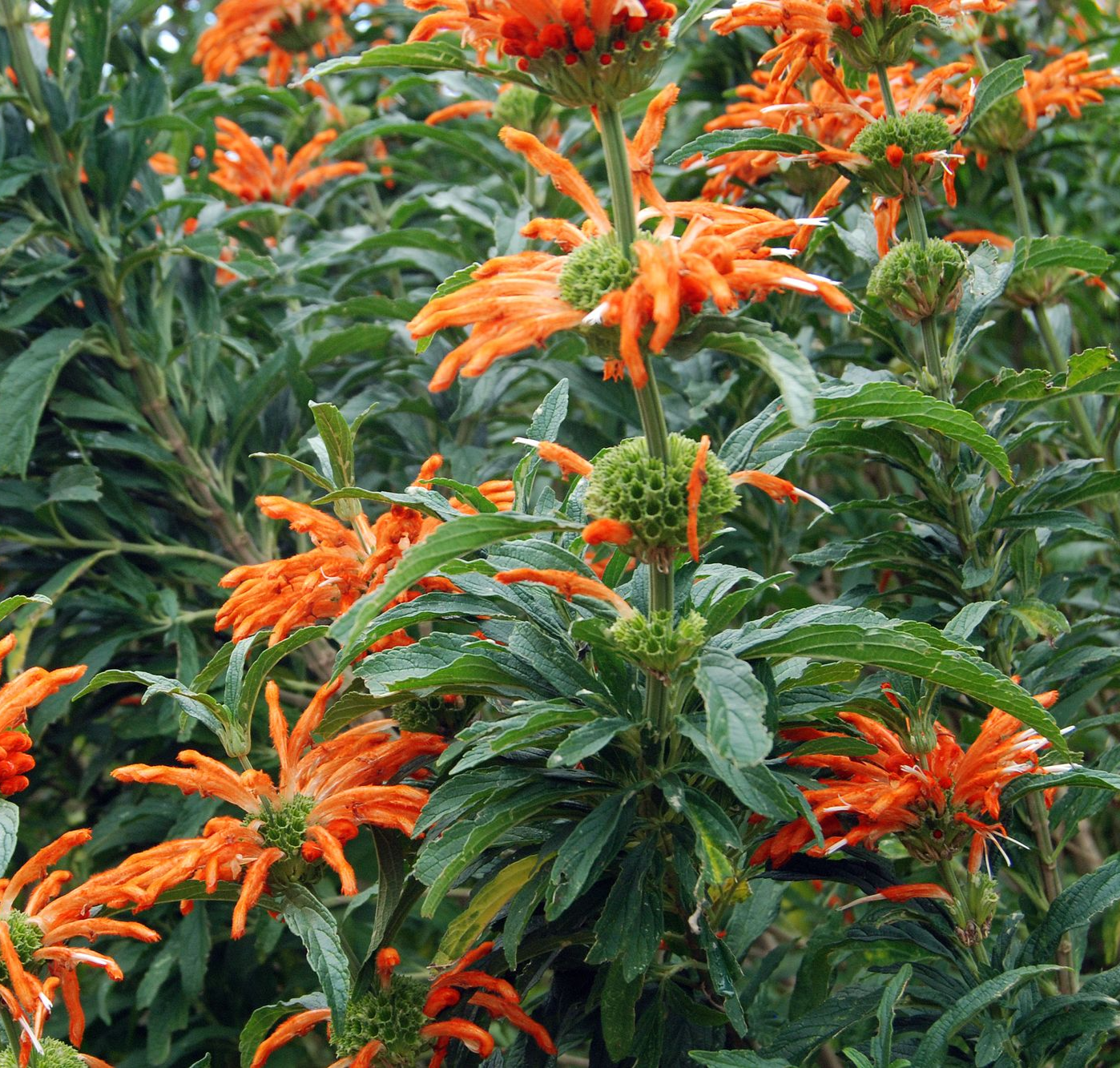
Botanical Description: Annual upright herb, can grow up to 6-9 feet high.Oppositely arranged along the stems and borne on stalks. Lower leaves are oblong-ovate to ovate and larger and broader than those towards the top of the plant. All leaves have distinctly toothed margins, pointed tips and are sparsely hairy. Flowers born in dense rounded clusters towards the tops of the stems. Each cluster is arranged directly on the main stem, just above a pair of leaves. Individual flowers are orange to reddish-orange in color and tubular in shape with two main lobes. Flowers are surrounded by a green calyx tube and have two elongated and pointed green bracts.
Habitat: This species is mostly found in tropical regions, but also grows in sub-tropical and warmer temperate areas. It is a weed of roadsides, overgrazed pastures, disturbed sites, waste areas, waterways and floodplains.
Parts Used: Leaves and Flowers
Key Constituents: alkaloids, tannins, saponins, flavonoids, steroids, and terpenoids, phenolics, glycosides, coumarins, anthocyanins
Herbal Actions: antimicrobial, anti-inflammatory, antioxidant, analgesic, mood-lifter
Taste: Bitter
Some Ways To Work With This Plant:
Pain Management --Studies suggest that teas or tinctures made with the leaf inhibits the sensation of pain and is anti-inflammatory and therefore is used in the management and/or control of painful, arthritic, and other inflammatory conditions.
Heart Tonic— Klip Dagga is an excellent heart tonics and used for heart conditions associated with anxiety and tension and will calm palpitations, tachycardia and irregular heartbeats.
Mood lifting — the dried leaves and flower have a euphoric-like effect and exuberance. Making a tea or smoking the leaves and flowers are the best way to experience this effect.
Bronchial Asthma — The stem, leaves, and flowers contain flavanoids that support in the treatment of Asthma. These flavanoids offer protection against oxidative damage. A decoction from the stem, leaves, and flowers can be made for this purpose.
Skin Diseases — The whole plant contains strong anti-fungal and antibacterial properties due to its high levels of tannins, flavanoids, alkaloids, terpenoids, and polyphenols. The flower, leaf, and stem have antibacterial properties against Staphylococcus aureus, a pathogen that causes eczema. The whole plant is powdered and mixed with oil and applied topically for skin support.
Herbal Preparations:
Tea— Add 1-3 tsp of dried flower and leaf in 8oz of water of boiled water. Cover and let steep for 15 mins. Strain and drink.
Smoke Blend — Dry flowers and leaves. Break up into smaller pieces via an herb grinder. Add to a blend with mullein and lemon balm or smoke by itself.
Tincture — 1 part Fresh leaf and flower to 2 parts 80proof alcohol.
References:
Gang R and Kang, Y. Botanical features and ethnopharmacological potential of Leonotis nepetifolia (L.) R. Br: a review. J Plant Biotechnol 2022; 49(1): 3-14, 2022.
written by khadija khansia
This information is provided for educational purposes and is not intended to diagnose, treat, cure, or prevent any disease. Use with caution and consult with a doctor or herbalist before consuming if you are pregnant or on other medications. Please do your own research before consuming to know if this medicine is right for your body.