Calendula
Calendula officinalis
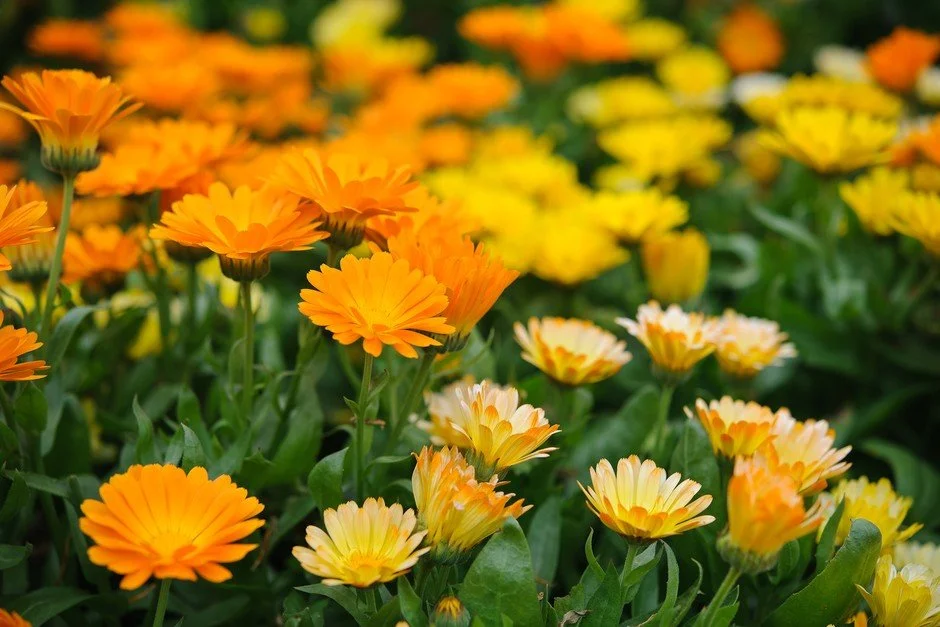
Latin Name: Calendula officinalis
Common Name: Marigold, Pot Marigold
Family: Asteraceae
Contraindications: Do not take internally if pregnant. May not be best for people with overly hot consitution.
Native To: Originally native throughout Europe. Naturalized throughout North America and other parts of the world.
Botanical Description: Annual plant in temperate regions with waxy, smooth, or glandular stems. The simple leaves can be somewhat toothed and are borne alternately along the stems. The composite flower heads, borne singly, consist of yellow or orange ray flowers and central disk flowers that can be yellow in color. The fruit is a curved.
Habitat: easy to grow in average, moderately fertile, well-drained soils in full sun. Marigolds also do well with some shade during hot summers, but become leggy in too much shade.
Parts Used: Flowers and Leaves. Make sure to use the resinous green base of flowerhead to get most potent medicine.
Key Constituents: Triterpenes (calendulosides A-D), carotenoids, flavonoids (isoquercitrin, narcissin, rutin), volatile oils and resins, chlorogenic acid, polysaccharides, minerals (iodine- primarily found in the leaf)
Herbal Actions: Lymphagogue, Alterative, Vulnerary, Astringent, Bitter Tonic, Cholagogue, Inflammation Modulator, Emmenagogue, Immune Tonic
Taste: Bitter, slightly sweet, salty, pungent
Energetics: warming
Some Ways to Work With This Plant:
Lymphatic Draining — Calendula is really great at stimulating the lymphatic fluids which contain white blood cells that support in clearing out waste in the body. As a result, calendula is great for bringing in movement in areas where there is stagnation and build up in blood and lymphatic fluids from a recent cold or infection. Perfect for lingering and unresolved infections, calendula goes to work by draining swollen lymph nodes.
Wound Healing/ Skin Support — Calendula contains flavanoids and carotenoids that lend to its wound healing abilities. Calendula’s ability to keep wounds clean and clear of infection and to speed up wound healing is due to it’s ability to stimulate lymphatic flow in the area of the wound. Lymphatic fluid contains white blood cells which help fight off infection and help heal.
Liver Detoxification— Calendula contains triterpenes that are responsible for it’s bitter taste which make it a great remedy for to move liver stagnation. The bitter principle in calendula stimulates bile production in the liver which helps to support digestion and support in clearing out metabolic waste congesting the blood and liver.
Food Intolerance, Leaky Gut, Antibiotic Trauma — Antibiotics impair digestion, lower immunity and host resistance, and heighten sensitivity to anything that comes in contact with digestive system. This heightened digestive sensitivity can cause chronic inflammation and bloating and weaken the gut wall, making it more permeable or “leaky”. A leaky gut causes larger than normal substances to cross gut wall which leads to congestion of liver, blood, lymph. Just like how calendula’s ability to tighten and repair wounds and bring blood to a wounded site can help repair our outer skin, it can do the same to help repair our inner skin aka our gut. Calendula’s contains flavanoids and triterpines that allow it to modulate inflammation supports in bringing down inflammation and it’s ability to stimulate the lymphatic system supports in clearing out congestion in GI, blood, lymph, and liver caused by stagnant waste that causes bloating in GI system.
Emmenagauge, Menstrual Support, and Pospartum Healing Support — Calendula helps stimulate stagnant menses, and it’s warming property brings circulation and clears uterine congestion and stagnation. It’s lymph stimulating properties and bitter principle supports in releasing postpartum vaginal discharge and healing vaginal wall tears.
Herbal Preperations
Tincture: 1 part dried calendula in 5 parts 140proof alcohol. Let it extract for 4-6 weeks, then strain. Can take up to 1tsp daily depending on needs. Great way to extract resins, volatile oils, and triterpines.
Oil: Fill jar with dried calendula flowers. Cover completely with oil and let it extract 4-6 weeks, then strain. Apply topically for wound healing support. Great way to extract resins, volatile oils, and triterpines. Some plants to combine it with are plantain
Tea: Add 2-3 tablespoons to 1 cup of boiled water and let steep for 20 mins with lid on. This tea can be consumed internally or can be use for a sitz bath to aid in postpartum healing (just make sure the temp is too hot!)
Add dried flowers to bone broth to give that broth lymph stimulating properties and that can support a person during and after sickness.
References:
Popham, S. Materia Medica Monthly: Calendula Monograph
written by khadija khansia
This information is provided for educational purposes and is not intended to diagnose, treat, cure, or prevent any disease. Use with caution and consult with a doctor or herbalist before consuming if you are pregnant or on other medications. Please do your own research before consuming to know if this medicine is right for your body.