Feverfew / Matricaria
Tanacetum parthenium
Latin Name:Tanacetum parthenium
Common Name: Featherfew, Featherfoil, Flirtwort, Midsummer Daisy
Family: Asteraceae
Contraindications: Do not take if pregnant or chest-feeding. Not safe for children. Do not take if you are allergic to Asteraceae family (aka daisy family). Do not take if on blood thinning medication. Eating too many leaves can cause blistering of the mouth. Do not take if you have a bleeding disorder or are on blood-thinning medication. Consult with clinical herbalist if you are taking SSRIs or estrogen as feverfew decreases prostaglandin levels which can have compounding impacts when coupled with estrogen and SSRIs. To see how your medication may interact with this plant, check this database, consult with your local herbalist, and do your own research before working with any plants.
Native To: Western Asia and Balkan regions of Europe. Naturalized over time throughout the remaining parts of Europe and much of north america including both southern Canada and the u.s. except for the Great Plains states and Arizona to Florida
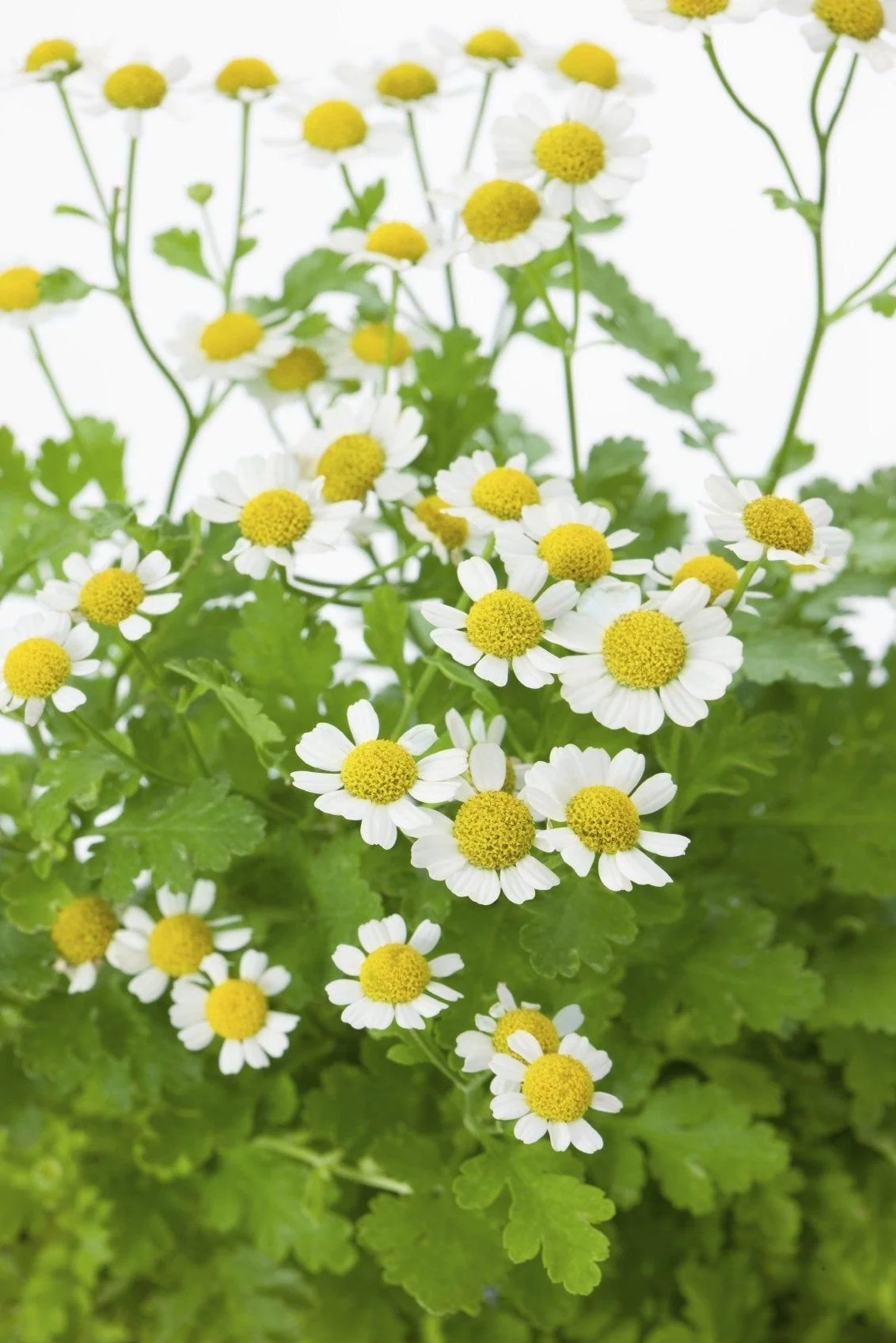
Botanical Description: weedy, bushy, aromatic, herbaceous perennial; grows 3’ tall and features a lengthy summer bloom (June-September) of small, 3/4”, daisy-like flowers with white petals and button-like yellow center disks. Flowers are arranged in dense corymbs. Pinnately lobed leaves (to 2-3” long) are deeply cut or parted nearly to the midrib. Leaves are strongly scented, toothed and slightly hairy below.
Habitat: Found in glades, upland prairies, rocky open woods, forest openings, ledges and tops of bluffs, savannas, pastures, and roadsides in north america.
Parts Used: Flowers, Leaves, Soft Stems
Key Constituents:
Sesquiterpene lactones (parthenolide)
Volatile oils
Bitter resin
Pyrethrin
Tannins
Flavonoids (apigenin, centaureidin, chrysoeriol, jaceidin, luteolin, quercetin, santin)
Herbal Actions: Anti-inflammatory, Anodyne, Antipyretic, and Headache Remedy
Taste: Bitter, Pungent, Acrid, Spicy
Energetics: Cooling, Drying
Some Ways To Work With This Plant:
Anti-Inflammatory/Pain Relief— Feverfew decreases pain by decreasing inflammation. The sesquiterpene lactone parthenolide blocks the transcription of inflammatory proteins and thus is the core constituent responsible for feverfew’s anti-inflammatory response. Parthenolide is soluble in alcohol and is not soluble in water. Feverfew works best for chronic inflammation not acute inflammation. It is great for chronic inflammation due to injury or infection (like Lyme).
Headache Relief — Feverfew works best when used as a long term preventative headache relief medicine vs for acute pain. Fever inhibits the release of serotonin and reduces the amount of prostaglandin, histamine, and other substances which cause inflammation. This causes decreases swelling in the brain and migraine relief. Combines well with chamomile and blue vervain for headache remedy.
Fever Reducing — Feverfew reduces fever by reducing prostaglandin and other inflammatory molecules that initiate fever.
Herbal Preperations
Tincture-fresh flower and leaf. 1:4 in 80%alcohol
Tincture-dried flower and leaf. 1:5 in 50% alcohol
Glycerite-freshly dried flower and leaf. 1:7 in vegetable glycerin. Then put into a hot water bath for 1.5 hours.
Dosage: start with 5 drops and increase dosage as needed.
References:
Pareek et al. Feverfew (Tanacetum parthenium L.): A Systematic Review.
Pharmacognosy, 2011 7song. Northwest School for Botanical Studies Course.
Feverfew Monograph Reuter U, Chiarugi A, Bolay H, et al. Nuclear factor-kappaB as a molecular target for migraine therapy.Ann Neurol. Apr 2002;51(4):507-516.
written by khadija khansia
This information is provided for educational purposes and is not intended to diagnose, treat, cure, or prevent any disease. Use with caution and consult with a doctor or herbalist before consuming if you are pregnant or on other medications. Please do your own research before consuming to know if this medicine is right for your body.