Spilanthes
Spilanthes acmella
Latin Name: Spilanthes acmella
Common Name: Buzz Buttons, Electric Daisy, Toothache Plant
Family: Asteraceae
Contraindications: Spilanthes should not be taken for long periods of time, and it may not be safe for those with autoimmune conditions. It may cause allergic reactions in those with allergies to plants in the daisy family (Asteraceae). Numbing effects can be strong so be cautious of large doses. It many not be safe for those taking diuretics.
Native To: Abya Yala (specifically Peru and Brasil), Southeast Asia and China
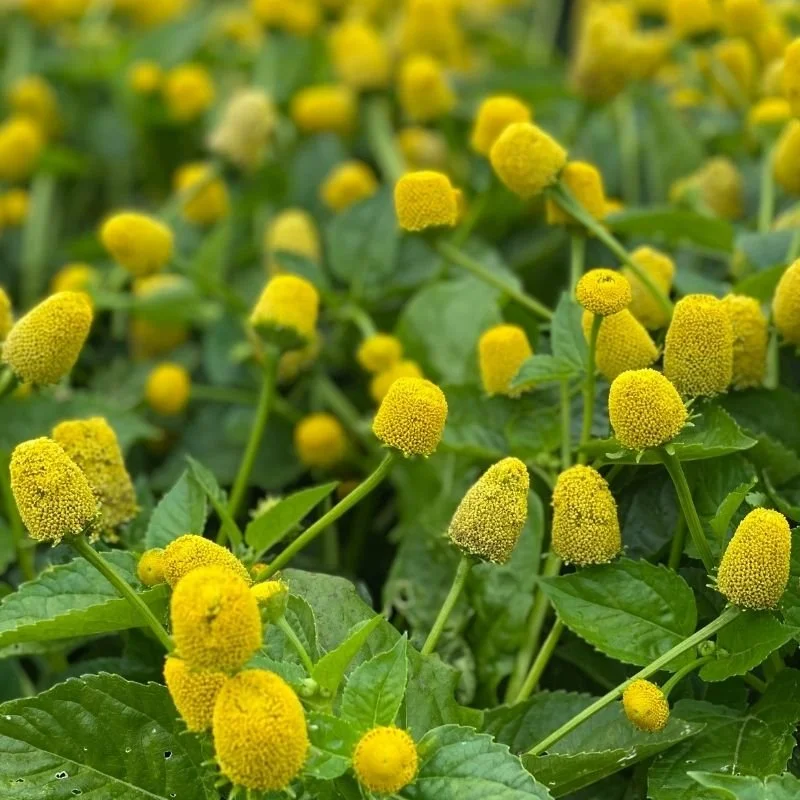
Botanical Description: Herbaceous perennial growing to about a foot in height and one to two feet in width. It has erect stems and ovate, toothed leaves, which come together to form a sharp tip at the end. The flower heads are elongated and often have a red-tipped center, though some are all yellow.
Habitat:
Parts Used: Flowers and leaves
Key Constituents: Spilanthol, Acmellonate
Herbal Actions: Analgesic/Anodyne, Antimicrobial, Astringent, Diuretic, Immune Stimulant, Sialagogue
Taste: pungent, bitter
Energetics: Mildly Warming, Mildly Drying, Stimulating, Dispersing
Some Ways to Work With This Plant:
Oral/Dental Care — It can be eaten fresh or turned into a tincture and used as mouth wash to keep teeth clean and support in tootaches. The plant can be dried and turned into powder but it lessens in potency with time and when it is dried. It promotes production of saliva which supports in cleaning mouth. Spilanthes is also antimicrobial so this helps it’s function in oral care.
Immune Stimulating — Spilanthes has alkamides (spilanthol) and polysaccharides that contribute to it’s immune stimulating ability. It does by increasing macrophage activity. Macrophages are a type of white blood cell that surrounds and kills microorganism, removes dead cells, and stimulates the action of other immune system cells.
Herbal Preparations:
Tea: 1 – 2 tsp. (dried or fresh aerial parts) per 8 oz water up to up to 3x per day
Tincture: 1 part fresh plant to 2 part 95% alcohol. Let it steep for 4-6 weeks then strain. Take 2 – 4 dropper ful 3 times a day.
References:
Blankespoor J. The Healing Garden. Mariner Books; 2022.
Dubey S, Maity S, Singh M, Saraf SA, Saha S. Phytochemistry, Pharmacology and Toxicology of Spilanthes acmella: A Review. Advances in Pharmacological and Pharmaceutical Sciences. 2013;2013:e423750. doi:10.1155/2013/423750
Easley T, Horne S. The Modern Herbal Dispensatory: A Medicicne-Making Guide. North Atlantic Books; 2016.
Mountain Rose Herbs. Spilanthes. Mountain Rose Herbs. https://mountainroseherbs.com/spilanthes
Paulraj J, Govindarajan R, Palpu P. The Genus Spilanthes Ethnopharmacology, Phytochemistry, and Pharmacological Properties: A Review. Adv Pharmacol Sci. 2013;2013:510298. doi:10.1155/2013/510298
Ramachandran RG, Radhakrishnan R. Anatomical Characterization of Nine Taxa of Genus Acmella Rich. (Toothache Plant) in India. Braz arch biol technol. 2020;63:e20190083. doi:10.1590/1678-4324-2020190083
Sharma R, Arumugam N. N-alkylamides of Spilanthes (syn: Acmella): Structure, purification, characterization, biological activities and applications – a review. Future Foods. 2021;3:100022. doi:10.1016/j.fufo.2021.100022
Spilanthes acmella | Memorial Sloan Kettering Cancer Center. https://www.mskcc.org/cancer-care/integrative-medicine/herbs/spilanthes-acmella-jambu
written by khadija khansia
This information is provided for educational purposes and is not intended to diagnose, treat, cure, or prevent any disease. Use with caution and consult with a doctor or herbalist before consuming if you are pregnant or on other medications. Please do your own research before consuming to know if this medicine is right for your body.